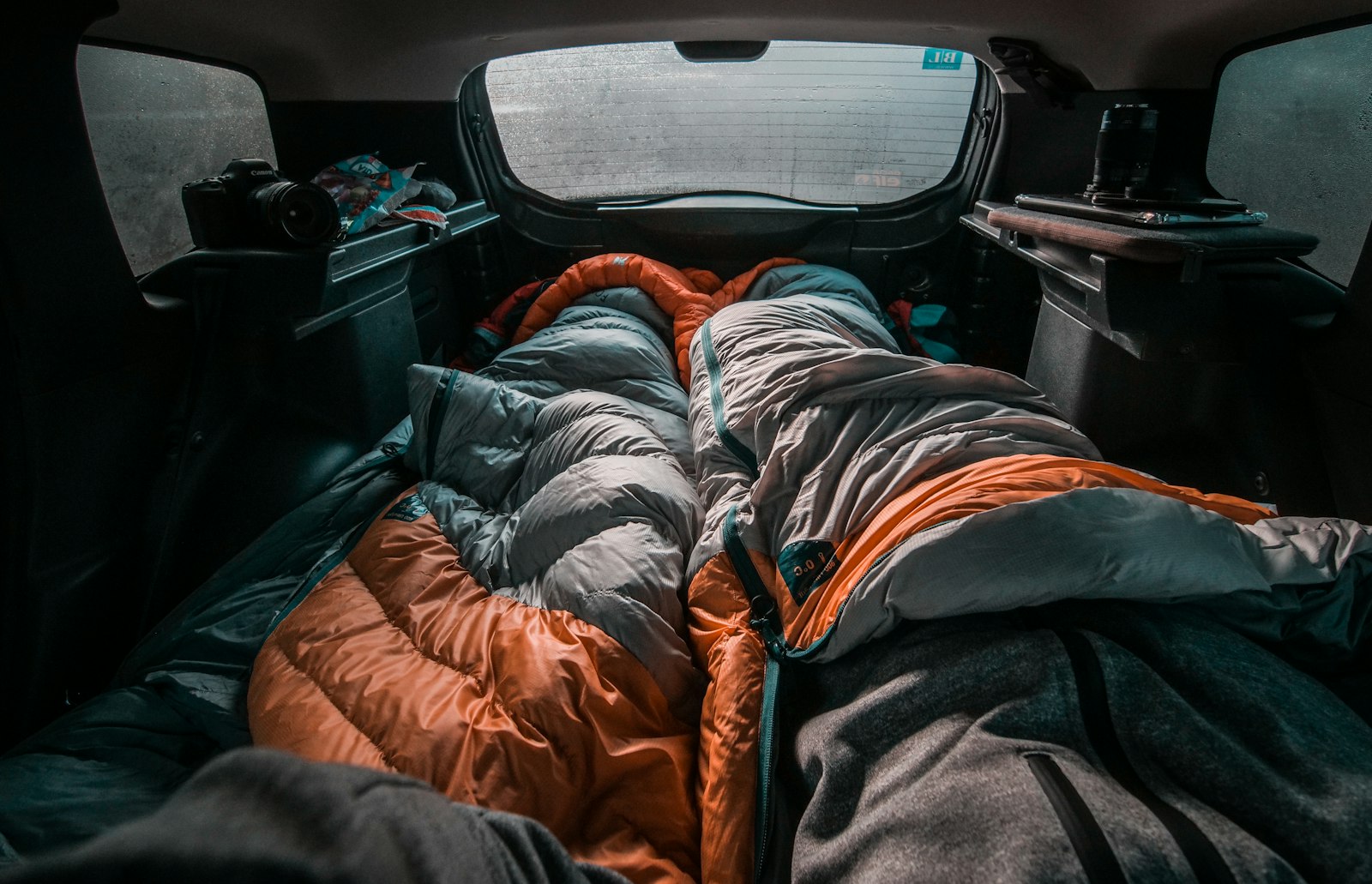
Most cold nights at camp start from below. You crush the insulation under you when you lie on a sleeping bag, so the bag does very little on that side. The ground then pulls heat away all night. That’s why a good pad matters as much as the bag in winter, and why the pad’s R-value is the number to check first.
What R-value means
R-value measures how well something resists heat flow. For a sleeping pad, a higher number means less heat lost into the ground. Until 2020, brands tested this in different ways, so a 4 from one company didn’t always mean a 4 from another. The ASTM F3340 standard, developed by a group of brands including REI and Therm-a-Rest, fixed that. Now pads tested to the standard can be compared directly.
One handy rule from Therm-a-Rest’s maker, Cascade Designs: closed-cell foam gives roughly R-3 per inch of thickness. Older air pads from before 2000 often rate below 2, which is why an old pad from the garage can feel freezing on a frosty night.
How much R-value do you need?
REI pairs pad R-values with expected overnight lows and sleeping bag ratings like this:
| Conditions | Night low | Pad R-value | Bag rating |
|---|---|---|---|
| Warm | 50°F (10°C) | Under 2 | 30°F or lower |
| Cool | 32°F (0°C) | 2 to 3.9 | 20°F or lower |
| Cold | 20°F (−7°C) | 4 to 5.4 | 15°F or lower |
| Extreme | 0°F (−18°C) | 5.5 or more | 0°F or lower |
For most people overlanding through late autumn and winter, a pad around R-4 to R-6 is the useful range. If you sleep cold, aim higher. Many campers also add a cheap foam pad under an air pad. It adds warmth, and if the air pad punctures, you still have something between you and the ground.
Reading sleeping bag ratings
Most bags in Europe, and many sold in the US, are tested to EN ISO 23537. It gives up to three temperatures, and the difference between them matters:
- Comfort: the lowest temperature at which a typical person can sleep in a relaxed position.
- Limit: the lowest temperature at which someone curled up and fighting the cold can still sleep through the night.
- Extreme: a survival figure only. You could stay in the bag for about six hours, with a real risk of frostbite.
Many bags are named after their limit rating, not the comfort rating. So a “20°F bag” might only be comfortable for many people at around 30°F. If you tend to feel the cold, plan around the comfort figure.
Rooftop tents and cots
Sleeping off the ground doesn’t solve the problem. A rooftop tent floor is usually an aluminium or fibreglass base with a foam mattress, and cold air moves underneath it. The stock mattress is often fine in summer but thin for real winter nights. Adding an insulated pad on top, or a wool blanket under you, makes a big difference. Cots are similar. Air passes right under the fabric, so a pad on a cot needs as much R-value as one on the ground, sometimes more.
Condensation is the other winter issue in rooftop tents. We cover that in our guide to tent condensation.
A simple winter sleep system for vehicle camping
Because you carry it in a vehicle, you don’t have to save weight like a backpacker. That makes winter sleep much easier and cheaper. A setup that works for many people looks like this:
- A closed-cell foam pad at the bottom, for insulation that can’t puncture.
- An insulated air pad or self-inflating mattress on top, for comfort and extra R-value.
- A sleeping bag with a comfort rating near the coldest night you expect.
- A blanket or quilt over the bag on the coldest nights.
Test it on a cold night close to home first. Then you’ll know where your limit is before you’re hours from the nearest town.
Small habits that help
- Eat something with fat or protein before bed. Your body needs fuel to make heat.
- Change into dry base layers for sleeping. Clothes damp from the day will chill you.
- Wear a warm hat, and keep tomorrow’s clothes in the bag so they’re not frozen.
- Use a hot water bottle, filled from the stove and sealed tight, at your feet.
- Get up to pee. Your body wastes heat keeping a full bladder warm.
Never bring a gas heater or a stove into a closed tent to warm it up. Carbon monoxide builds up quickly. If you want heat, read our guide to heating a tent safely with a diesel heater first, and see our winter overlanding checklist for the rest of the cold-weather kit.
FAQ
Do R-values add up when you stack pads?
Broadly, yes. Two pads give you roughly the sum of their R-values, which is why a foam pad under an air pad is such a common winter setup.
Is a higher R-value too warm in summer?
Not really. A pad doesn’t make heat, it just slows heat loss to the ground. You can use a high-R pad all year and adjust with your bag.
Sources
- REI – Just how warm is that sleeping pad?
- Cascade Designs – What is R-value?
- Rab – Sleeping bag temperature ratings explained
Temperature pairings are general guidance. Everyone sleeps differently, so test a new setup close to the vehicle before you rely on it on a cold trip.
Featured photo: Lucas Favre on Unsplash.