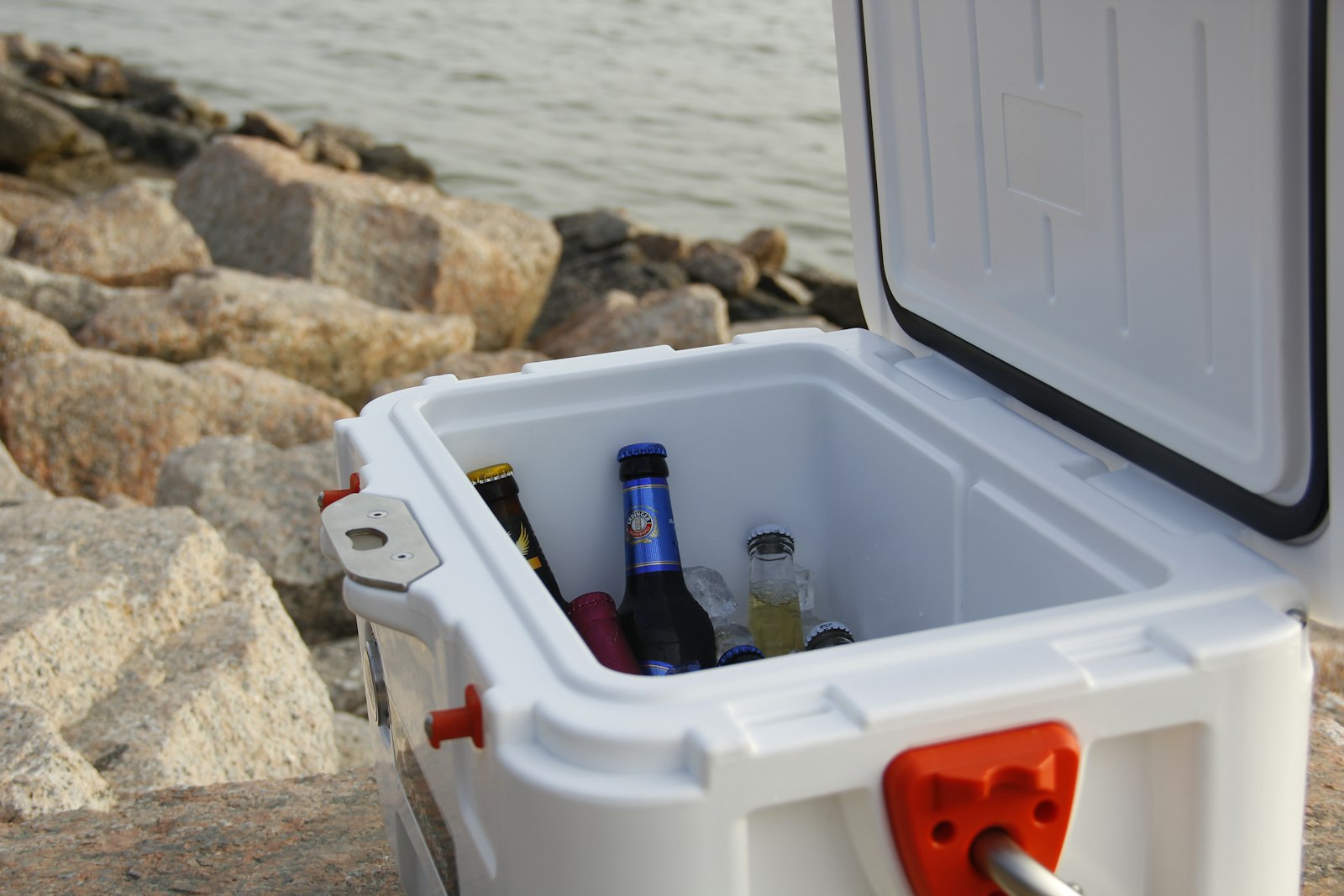
Keeping food cold is one of the first real decisions in an overland setup. A good cooler with ice costs a fraction of a 12V compressor fridge and needs no electrics. A fridge costs more and needs a power system, but it never needs ice and keeps food at a steady temperature for as long as you have power. Which one makes sense depends mostly on how long you’re away and how often you can buy ice.
Side by side
| Cooler with ice | 12V compressor fridge | |
|---|---|---|
| Up-front cost | Low to moderate | High; quality 35–40L models often cost around $800 or more |
| Running cost | Ice on every trip | Battery power; needs a 12V system to run off-grid |
| Temperature control | Gradually warms as ice melts | Set and hold a temperature; many can freeze |
| Usable space | Ice takes up a big share | All of it is for food |
| Meltwater | Yes; food can end up sitting in water | No |
| Best for | Weekends and trips with regular ice stops | Longer trips, remote areas, hot weather |
What a fridge actually uses
The key number for a fridge is its power consumption, usually given in amp-hours per hour (Ah/h) at a stated room and fridge temperature. Dometic, for example, lists its 36-litre CFX3 35 at 0.98 Ah/h at 90°F (32°C) outside and 39°F (4°C) inside.
That works out to about 23.5Ah over 24 hours in hot weather. A 100Ah lithium battery with nearly all its capacity usable could run that fridge for roughly four days in those conditions with no charging at all. In cooler weather it uses less, and with daily driving or solar it can run indefinitely. In practice, opening the lid often, packing it warm and leaving it in the sun all push consumption up.
If you’re going down the fridge route, the next step is a power system. Our 12V power guide and DC-DC charger guide explain how to set one up.
Getting the most from a cooler
- Pre-chill it the night before with a sacrificial bag of ice, then load cold food and fresh ice.
- Use block ice for the base; it lasts longer than cubes. Frozen water bottles double as drinking water later.
- Keep it full. Empty space warms faster, so fill gaps with ice or a towel.
- Keep it shaded and off hot metal floors. A cover or insulated bag helps.
- Use two coolers if you can: one for drinks that gets opened all day, one for food that stays shut.
- Drain meltwater regularly and keep raw meat sealed and at the bottom.
Keep food safe either way
Perishable food should stay at or below 40°F (4°C). A cheap fridge thermometer tells you whether your cooler or fridge is really holding that, which is easy to get wrong on a hot day.
Which should you choose?
- Weekend trips, near towns, tight budget: a good cooler. Spend the savings on recovery gear or tyres.
- Trips of four days or more, remote areas or hot weather: a 12V fridge. No ice runs, no soggy food and much more usable space.
- Already planning a dual battery system: a fridge, because you’ll have the power anyway.
Many people start with a cooler and switch to a fridge once they travel longer. That’s a sensible path: you learn what you really need before spending the money.
Quick answers
How much power does a 12V fridge use per day?
It varies by model and conditions. One example, Dometic’s CFX3 35, is rated at 0.98 Ah/h at 90°F outside, or about 23.5Ah a day in that heat.
Can I run a 12V fridge from my starter battery?
Only for short periods. Most fridges have low-voltage cut-off settings to protect the starter battery, but an auxiliary battery is the proper solution.
How long does ice last in a cooler?
It depends heavily on the cooler, the weather, how full it is and how often you open it. Pre-chilling, block ice and shade make the biggest difference.
Sources
Featured photo: Sandrene Zhang on Unsplash.