
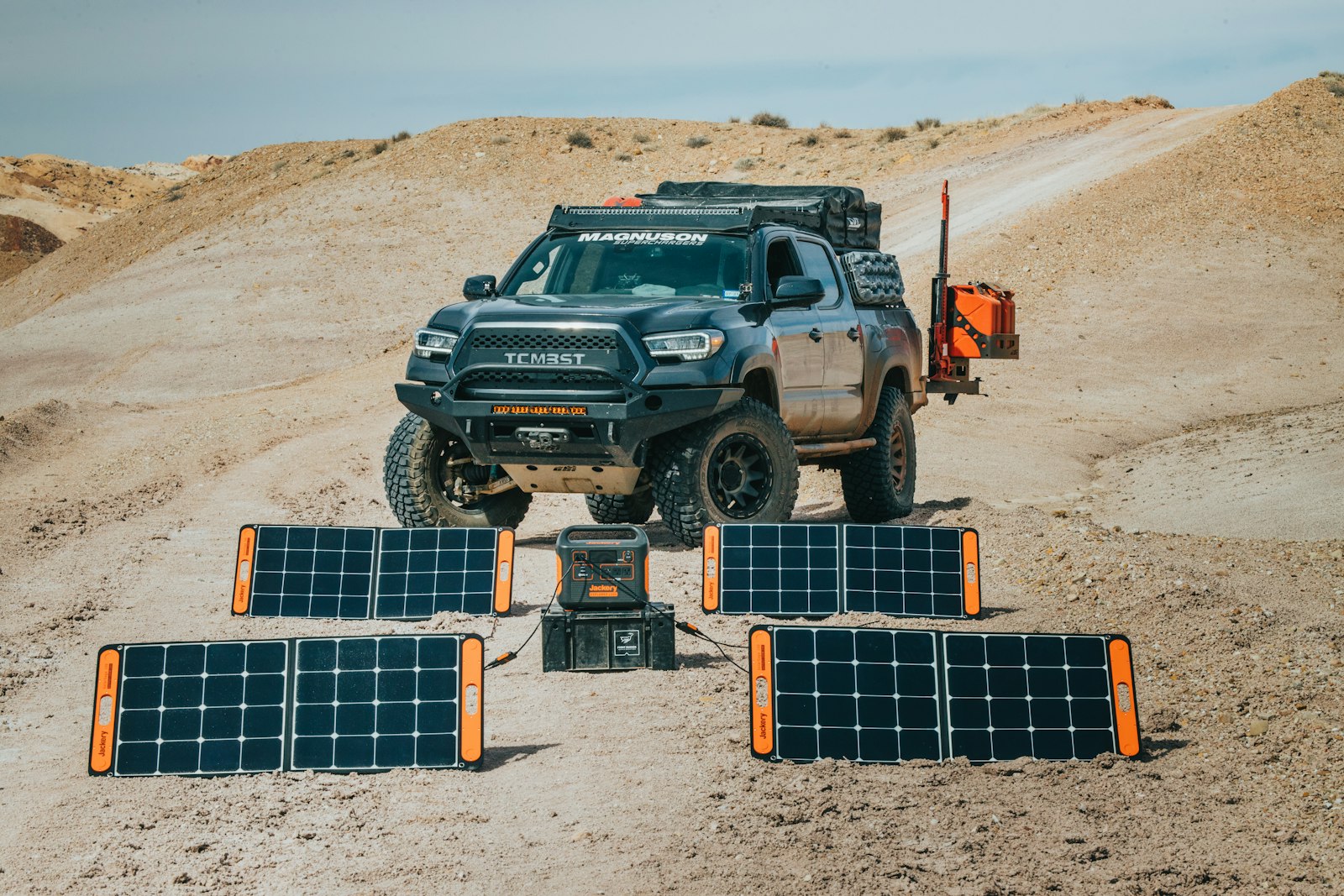
Use this free 12V power calculator to estimate the battery, solar and DC-DC charger your overland or camper setup needs. Add your devices, set how long you want to stay off-grid, and the results update as you type.
1. Your 12V devices
Pick a preset or type your own. Use average watts while running and hours per day.
| Device | Watts | Hours/day | Qty | Via inverter | Wh/day |
|---|
2. Your setup
3. What you need
Estimates only. Assumes a 12V system, ~75% real-world solar output, ~90% DC-DC efficiency, 15% inverter loss and 20% safety margin. Check your devices’ actual ratings and your manufacturer’s specs before buying.
How to size your overland battery and solar setup
This 12V power calculator helps with three decisions every overland build runs into. How big should the house battery be? How much solar keeps up with it? And what size DC-DC charger suits the driving you do? Here is how to use it and how to read the results.
What to enter in the 12V power calculator
Everything comes back to watt-hours per day. First, multiply each device’s average watts by the hours it runs. For example, a phone charger pulling 10 W for two hours uses 20 Wh. Add each device to the 12V power calculator above and it does the sums for you.
The fridge, however, is where most estimates go wrong. That is because the label shows the draw while the compressor runs, not the average over a day. Because the compressor cycles, a 40 to 50 litre fridge often averages 12 to 20 W in mild weather. In summer heat, expect more. If you already have a battery monitor, though, a 24-hour reading from your own fridge beats any preset.
Devices that run through an inverter cost extra, because converting 12V DC to mains AC wastes some energy. So when you tick the AC box, the calculator adds 15 percent. Big AC loads like an induction cooktop also need a properly sized inverter and heavy cabling, which this tool does not check.
How the 12V power calculator sizes your battery
First, daily watt-hours become amp-hours when divided by battery voltage: 12.8 V for lithium, 12 V for AGM. Next, the calculator multiplies that by the days you want to go without charging. Finally, it adds a 20 percent margin for cold mornings, battery ageing and forgotten loads.
Battery chemistry also changes the answer a lot. A LiFePO4 battery delivers most of its rated capacity, so 90 percent counts as usable. An AGM battery lasts longer if you stay above half charge, so only 50 percent counts. As a result, AGM needs roughly twice the capacity. Our lithium vs AGM comparison covers the trade-offs, and the LiFePO4 explainer covers daily use.
For example, take the default list: a 40 to 50 litre fridge, LED lights, phone charging and a diesel heater. That comes to about 516 Wh, or 40 Ah a day. For two days without charging, you therefore need about 107 Ah, so a 120 Ah lithium battery. With AGM, the same setup needs a 240 Ah bank.
Solar: covering a day, not filling a battery
The solar figure tells you how many watts of panels replace one day’s use. To get there, it divides daily watt-hours by peak sun hours. In addition, it assumes panels give about 75 percent of their rating once heat, angle, dust and the controller take their share.
Of course, peak sun hours vary with season and latitude. Four hours is a fair summer figure for much of Europe and the US, but northern winters can drop below two. For specific trips, the free Global Solar Atlas shows typical values for any location. In the default example, four sun hours means around 172 W, so a 200 W panel is a sensible target. Camping in shade or in winter? Plan for more panel, or lean on the alternator.
DC-DC charging from the alternator
Meanwhile, a DC-DC charger charges the house battery from the vehicle while you drive. In particular, it matters for lithium batteries and vehicles with smart alternators. Here, the calculator divides daily amp-hours by driving hours and allows for 90 percent efficiency. With the default list and two hours of driving, you need about 22 A, so a 25 A unit does the job.
However, bigger chargers need spare alternator capacity and heavier cable, so check your vehicle first. Our overland 12V power system guide shows how all the parts fit together. The REDARC REDWorks article covers one all-in-one approach.
Common mistakes to avoid
- Using the fridge’s rated draw as its daily average.
- Forgetting small loads that never switch off, like an idle inverter.
- Sizing solar for perfect summer sun, then camping under trees in October.
- Charging LiFePO4 below freezing. Most need built-in heating for that.
- Undersized cables, which waste energy as heat and can be a fire risk.
Treat the 12V power calculator as a starting point
In short, these results are estimates for a 12V system, not a wiring plan. After a few nights out, check your real daily use on a battery monitor and put it back into the 12V power calculator. Above all, confirm ratings, cable sizes and fusing with the manufacturer, or have an auto electrician check the final build.