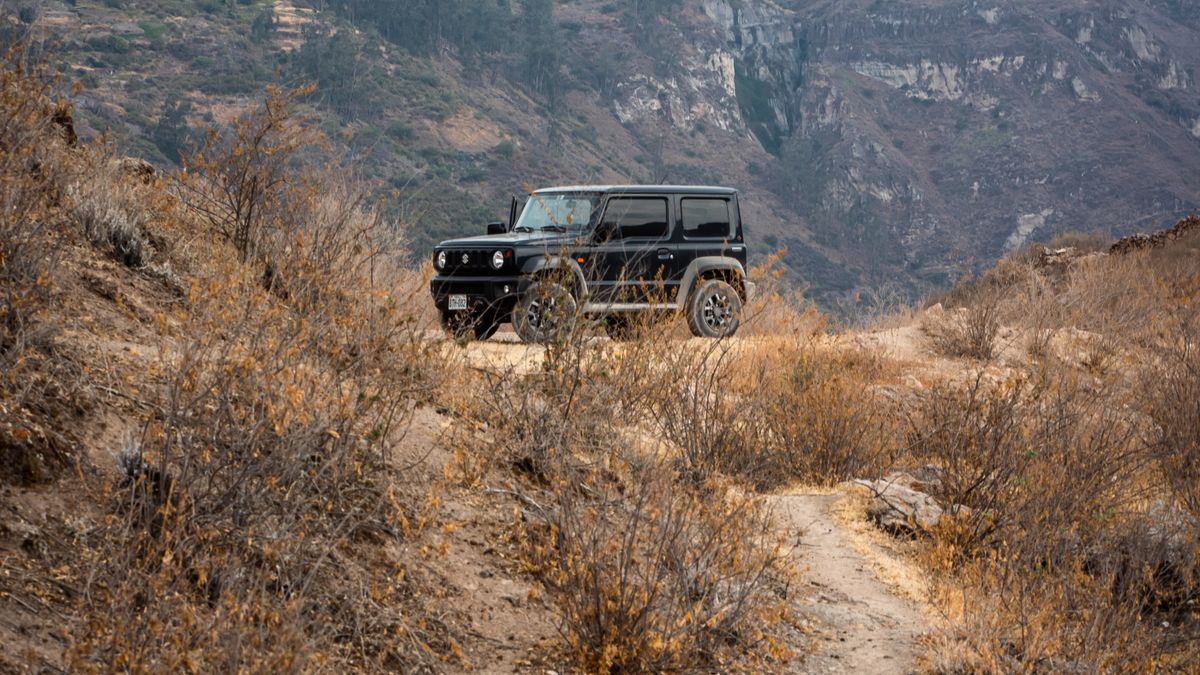
The three-door Jimny has always had one problem as a travel vehicle: there’s nowhere to put anything. With the rear seats up you get 85 litres of boot, which is a couple of soft bags and not much else. The five-door Jimny, sold in Australia as the Jimny XL, fixes the space problem by adding 340mm to the wheelbase. The question for overlanders is what that costs you, and whether the little Suzuki is now a realistic base for longer trips.
What changed with the five-door
Mechanically, very little. It’s the same 1.5-litre petrol engine (75kW and 130Nm), the same choice of five-speed manual or four-speed auto, the same part-time 4WD with low range, and the same live axles on coil springs front and rear. What changed is the body: the wheelbase grows from 2,250mm to 2,590mm, and overall length goes to just under four metres.
| Jimny XL (5-door) | |
|---|---|
| Engine | 1.5L petrol, 75kW / 130Nm |
| Gearbox | 5-speed manual or 4-speed auto |
| 4WD | Part-time, high and low range |
| Wheelbase | 2,590mm |
| Ground clearance | 210mm |
| Approach / departure | 36° / 47° |
| Boot (seats up / down) | 211L / 332L to the window line |
| Kerb weight / GVM | 1,185kg / 1,545kg |
| Towing (braked / unbraked) | 1,300kg / 350kg |
| Fuel tank | 40L |
Figures are for the Australian-spec XL. Other markets, including India where the five-door is built, may differ slightly.
Off-road: still very good, with one new compromise
Approach and departure angles barely suffer, because the overhangs are still tiny. The longer wheelbase does cost you breakover angle: reviewers list around 24° for the XL. In practice that means the five-door is more likely to belly out on a sharp crest or a deep washout that the three-door would have walked over.
The bigger off-road limits are the same as before. The standard 195/80R15 tyres are small, wheel travel is modest, so wheels lift early on cross-axle ground, and the traction control is slower to react than newer systems. None of that makes it a bad 4×4. It still goes places most small SUVs won’t, and the aftermarket for lifts, tyres and recovery points is huge.
The real limit for overlanding is payload
This is the number to look at before you start buying accessories. With a kerb weight of 1,185kg and a GVM of 1,545kg, the XL has roughly 360kg of payload. That has to cover the people, the gear and every accessory you bolt on.
Here is how fast it goes on a typical two-person setup:
- Two adults: about 160kg
- Roof rack and a small rooftop tent: 50 to 70kg
- Fridge, water, food and cooking gear: 40 to 60kg
- Recovery gear and a spare jerry can: 30 to 40kg
That’s already 280 to 330kg before a steel bar, a second battery or a heavier set of tyres. The lesson is simple: build light. An alloy rack, a ground tent or a lightweight rooftop tent, and a portable power station instead of a full dual battery install will keep you legal and keep the suspension happy.
Fuel range is the other weak spot
The official combined figure is 6.4L/100km, which would give more than 600km from the 40-litre tank. Real-world numbers on the highway are much worse. One Australian review recorded 12.2L/100km, with the engine turning about 3,000rpm at 100km/h in the auto. At that rate a full tank is good for about 330km, and less once you add a roof load and soft sand.
For remote trips that means planning fuel stops carefully or carrying a jerry can, which brings you straight back to the payload problem.
Where it makes sense
The Jimny XL is a good fit for one or two people who travel light, value a small footprint on tight tracks and don’t mind a slow, noisy highway run. It’s a harder sell for a couple carrying a full camp kitchen and water for a week, or anyone who wants to tow. The braked towing figure of 1,300kg rules out most off-road camper trailers.
It’s also not an option everywhere. Suzuki doesn’t sell cars in the United States, so the Jimny is not officially available there. In Australia, the 2026 Jimny range runs from A$30,490 to A$47,490 before on-road costs, depending on body style and spec.
Quick answers
Is the five-door Jimny better off-road than the three-door?
Not really. It keeps the same mechanicals and similar approach and departure angles, but the longer wheelbase reduces breakover clearance. What it gains is space and a calmer ride.
How much payload does the Jimny XL have?
About 360kg, based on a 1,185kg kerb weight and 1,545kg GVM. That has to cover passengers, gear and accessories.
Can the Jimny XL tow a camper trailer?
Only a light one. Braked towing capacity is 1,300kg, which is below the loaded weight of most off-road camper trailers.
Sources
- Suzuki – Jimny 5-Door world premiere
- CarExpert – Suzuki Jimny XL price and specs
- WhichCar – Suzuki Jimny XL Heritage review
- CarsGuide – Suzuki Jimny 2026
We haven’t driven the Jimny XL for this article. It’s based on Suzuki’s specifications and published reviews. Payload examples are typical weights, so weigh your own setup.
Featured photo: Renzo Alarco on Pexels.
Leave a Reply
You must be logged in to post a comment.