
In the modern world of overlanding, maintaining comfort in the heart of nature is no longer a luxury—it’s a standard. From fridges and lighting systems to drone charging and Starlink connectivity, your vehicle’s energy management has become the most critical factor in the success of your journey. But which technology should be the heart of your system? The traditional AGM or the next-generation Lithium (LiFePO4)?
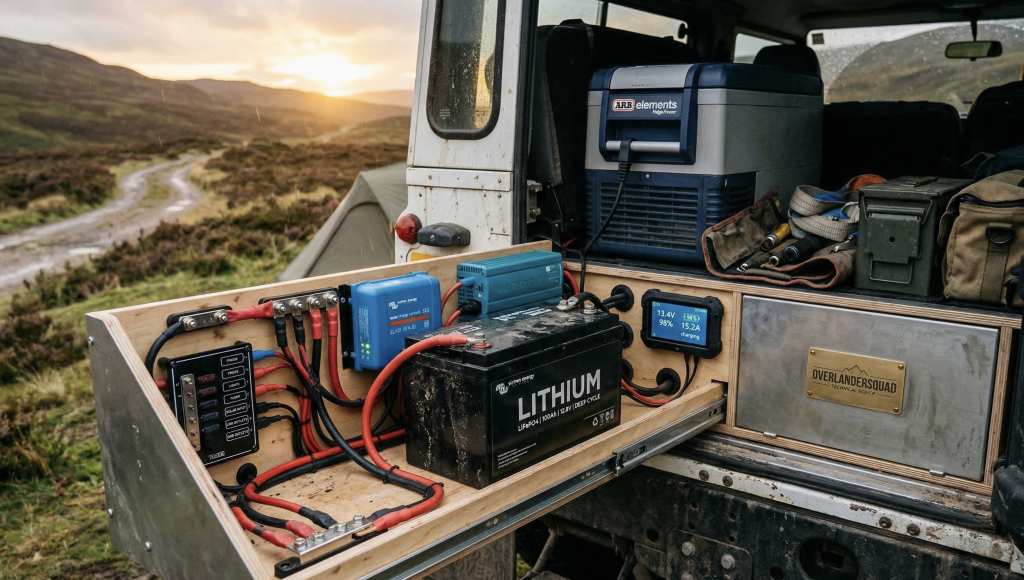
1. Usable Capacity and Depth of Discharge (DoD)
On paper, both batteries might show 100Ah (Amp-hours), but the reality in the field is quite different.
- AGM Batteries: For a healthy lifespan, it is recommended to discharge them to a maximum of 50%. This means from a 100Ah AGM battery, you can only effectively use 50Ah.
- Lithium (LiFePO4): This technology can be safely discharged to 80-95% of its capacity.
- The Verdict: A single Lithium battery provides almost double the usable energy of an AGM battery of the same rated capacity.
2. Weight and Space Efficiency: The Golden Rule of Overlanding
Every gram in your vehicle affects fuel consumption and off-road performance.
- Weight Factor: A typical 100Ah AGM battery weighs about 28-32 kg. The same capacity in Lithium is only 10-12 kg.
- The Advantage: Switching to Lithium can shave 40-50 kg off your vehicle’s load, while freeing up precious storage space.
3. Cycle Life and Return on Investment (ROI)
While the initial cost of Lithium might seem high, we must look at the “Total Cost of Ownership” from a professional perspective.
- Cycle Count: A high-quality AGM battery offers 300-500 cycles if well-maintained. Lithium batteries typically offer between 3000 to 5000 cycles.
- Long Term: By the time a Lithium battery reaches the end of its life, you would likely have replaced your AGM battery 3 or 4 times. This makes Lithium the more economical investment in the long run.

4. Charging Speed and Efficiency
Every amp from your solar panels or alternator is precious when you’re off the grid.
- Fast Charging: Lithium batteries have much lower internal resistance, allowing them to charge significantly faster. While AGM charging slows down as it nears full capacity, Lithium accepts high current almost until it’s completely full.
- Voltage Stability: Lithium provides a stable voltage (usually 12.8V – 13.2V) until the very end of its charge, ensuring your sensitive electronics run more efficiently.
5. Temperature Sensitivity: A Professional Note
Every technology has a weakness. For Lithium, it’s extreme cold.
Pro Tip: Lithium (LiFePO4) batteries should not be charged when the cell temperature drops below 0°C. If you enjoy winter camping, choosing models with internal heating (self-heating) is a professional necessity.
Editor’s Conclusion
If you only camp a few times a year, AGM remains a budget-friendly solution. However, for the long-term traveler and independent nomad, Lithium (LiFePO4) is the undisputed winner for its weight savings, longevity, and efficiency.
Leave a Reply
You must be logged in to post a comment.