
In the world of professional overlanding, a vehicle is more than just a means of transport; it is a complex engineering ecosystem. When preparing a rig for transcontinental expeditions, the margin for error is slim. Beyond the aesthetics of off-road modifications lies the most critical factor in vehicle safety and longevity: The Science of Weight Distribution.
At Overlander Squad, our editorial team analyzes the fundamental physics that separate a “built” rig from a truly capable expedition vehicle.
The Critical Balance: Center of Gravity (CoG)
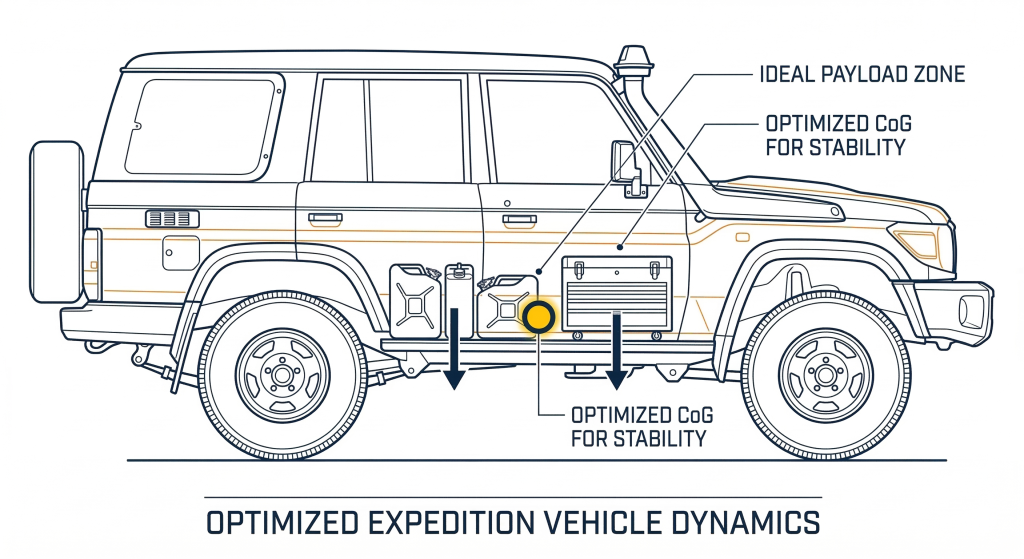
One of the most common mistakes in vehicle preparation is the over-utilization of roof space. While roof-top tents and fuel jerry cans are staples of the industry, placing excessive weight above the beltline significantly raises the Center of Gravity (CoG).
- The Editorial Standard: We recommend following the “60/40 Rule.” Ideally, 60% of your heavy cargo (water, tools, recovery gear) should be positioned between the axles and as low as possible.
- Performance Impact: A high CoG leads to increased body roll in technical off-road sections and dangerous instability during high-speed emergency maneuvers on tarmac.
Gross Vehicle Weight Rating (GVWR) and Payload Management
Every expedition vehicle has a hard limit: the Gross Vehicle Weight Rating (GVWR). Exceeding this limit is not just a matter of performance loss—it is a structural liability.
- Chassis Stress: Constant overloading leads to frame fatigue and eventual failure in corrugated desert tracks.
- Braking Efficiency: Kinetic energy scales with mass. An overloaded rig experiences significant “brake fade,” a critical risk during long mountain descents.
- Suspension Tuning: Professional builds must utilize “constant load” springs tailored to the final weight of the vehicle to maintain adequate travel and rebound control.
Unsprung Mass and Rotational Inertia
When discussing Vehicles & Equipments, we must address unsprung mass—specifically, tires and wheels. Heavy E-rated tires and steel beadlock wheels improve durability but increase rotational inertia.
- The Result: Increased strain on the drivetrain and reduced fuel economy. Overlander Squad recommends a balanced approach: utilizing high-strength alloy wheels and lightweight yet durable hybrid-terrain tires to optimize the power-to-weight ratio.
Conclusion: The Systematic Approach
Building a global expedition vehicle is an exercise in compromise. To achieve professional-grade performance, every piece of equipment added must be justified by its utility versus its weight. A rig that is balanced is a rig that is safe, efficient, and ready for the world’s most demanding routes.
Leave a Reply
You must be logged in to post a comment.